




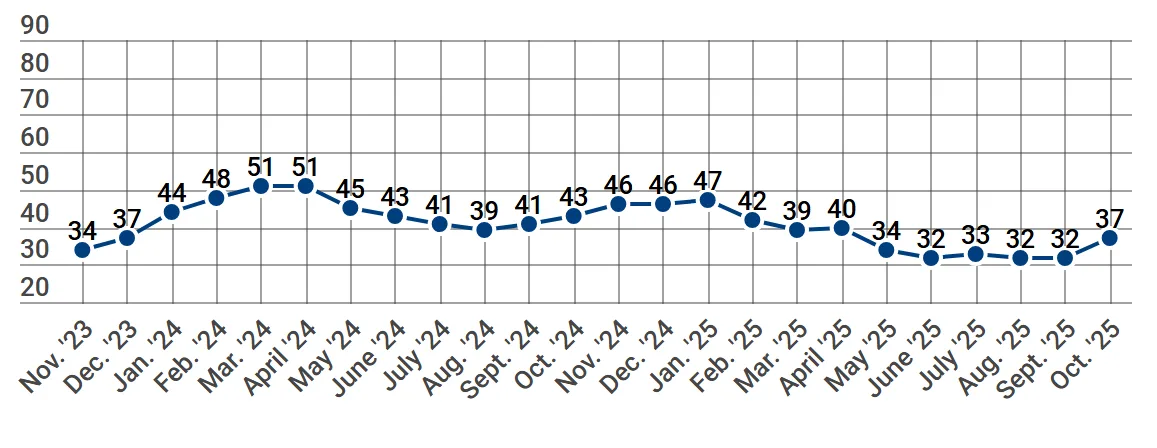
- Builder sentiment ticked up slightly in November, with the NAHB/Wells Fargo Housing Market Index rising one point to 38, but confidence remains well below the breakeven level of 50.
- Persistent headwinds, including elevated construction costs, a cooling labor market, and buyer hesitation tied to inflation and job security, are keeping housing demand soft.
- A record 41% of builders reported cutting prices in November, while 65% used sales incentives, signaling intensified efforts to attract buyers amid weak traffic.
Flat but Fragile: Builder Sentiment in November
Builder confidence in the new single-family home market edged up slightly in November, increasing just one point to 38, according to the latest NAHB/Wells Fargo Housing Market Index (HMI). The uptick reflects limited optimism as affordability remains under pressure despite easing mortgage rates.
Economic Headwinds Loom Large
While mortgage rates have come off recent highs, broader economic uncertainty is keeping many potential buyers on the sidelines. The recent record-long government shutdown, coupled with inflation concerns and a weaker labor market, are weighing heavily on consumer confidence.
“Buyers are still hesitant despite lower mortgage rates,” said NAHB Chairman Buddy Hughes. “Builders are leaning more on incentives, like price cuts, to close deals—but many shoppers remain cautious.”
This trend began earlier in the year, when builder confidence saw a slight bump in July as price cuts briefly spurred buyer activity, though momentum has since stalled.
Get Smarter about what matters in CRE
Stay ahead of trends in commercial real estate with CRE Daily – the free newsletter delivering everything you need to start your day in just 5-minutes
Incentives Rise as Sales Struggle
Ackman says relisting the shares offers President Trump a low-risk win, aligning with In a sign of ongoing market stress, 41% of builders reported cutting prices in November—the highest share since the post-Covid period began. The average price reduction remained at 6%, and 65% of builders used some form of sales incentive.
“We’re seeing persistent demand-side challenges,” said NAHB Chief Economist Robert Dietz. “2025 is shaping up to be a down year for single-family starts, but we anticipate a modest recovery in 2026.”
Component Breakdown
- Current sales conditions: Up two points to 41
- Future sales expectations: Down three points to 51
- Prospective buyer traffic: Up one point to 26
All three components remain below or just above neutral territory, with buyer traffic still especially weak.
Regional View
- Northeast: +2 to 48
- Midwest: -1 to 41
- South: +3 to 34
- West: +2 to 30
Regional variation suggests a slightly more positive outlook in the Northeast and South, while the Midwest and West continue to lag.
Why It Matters
With builder confidence stuck below the neutral mark, the broader housing market remains under pressure. While lower rates may provide some relief, it’s clear that economic uncertainty—from labor markets to inflation—is dampening both builder outlook and buyer activity.
What’s Next
As 2025 winds down, all eyes will be on whether lower rates and anticipated economic stabilization can drive a rebound in housing starts and builder sentiment heading into 2026. NAHB forecasts a modest improvement next year, but much will depend on job growth, inflation trends, and buyer confidence.