





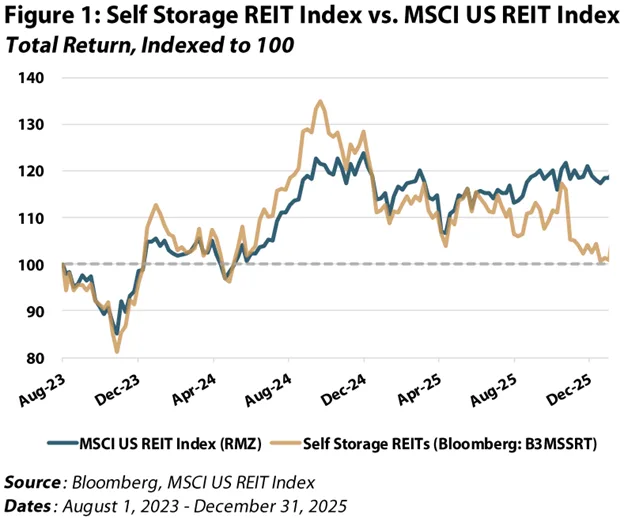
- Self-storage REITs have rebounded in early 2026, outperforming broader REIT indices year-to-date.
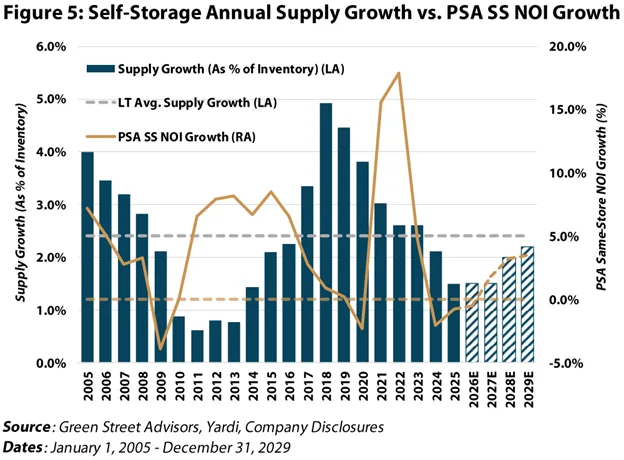
- Supply growth is expected to slow, potentially supporting fundamentals from 2027 onward.
- AI and digital integration are improving operational efficiency for leading operators.
- Housing turnover and rent recovery remain crucial for sustained sector growth.
Performance Trends Shift
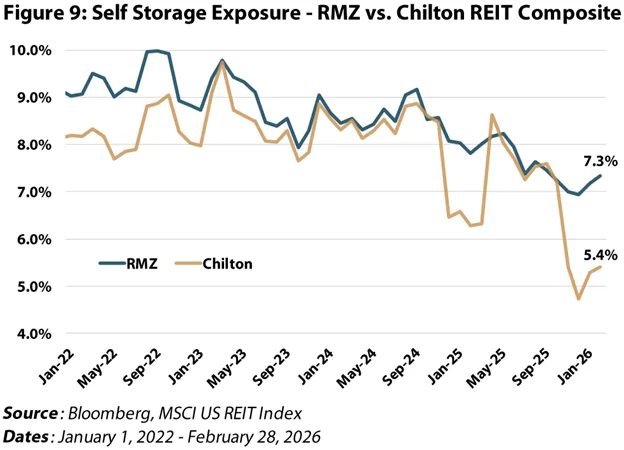
According to Chilton REIT Strategy, after lagging broader REIT benchmarks over the past two years, self-storage REITs posted a strong start to 2026, rising 17% year-to-date compared to an 11% gain for the MSCI US REIT Index. Sector underperformance in prior years reflected low housing turnover and pressure from elevated new supply.
Operators offset some challenges with expense controls and rent increases for existing tenants, but move-in rents and market fundamentals have yet to fully recover. As a result, sector positioning remains underweight for now despite recent gains.
Demand Drivers and Housing Impact
Self-storage REITs depend on life events—dislocation, divorce, downsizing, death, and decluttering—to drive demand. Housing turnover is a key driver, but US home sales remain subdued due to high mortgage rates and the lock-in effect for homeowners.
While policy efforts to address housing affordability and mortgage rates have boosted optimism, actual home sales data has not shown meaningful improvement. January 2026 saw an 8.4% monthly decline in existing home sales, tempering near-term expectations for a demand recovery in self-storage.
Get Smarter about what matters in CRE
Stay ahead of trends in commercial real estate with CRE Daily – the free newsletter delivering everything you need to start your day in just 5-minutes
Supply Dynamics Become Favorable
New supply is expected to ease, with annual growth forecast below the long-term average through 2027. Recent high development costs and conservative lender behavior are limiting new construction.
Lower supply today may serve as a tailwind for the sector in subsequent years. Historical cycles suggest self-storage REITs can regain strong NOI growth as competition from new facilities declines.
Tech Investment and Operator Performance
Adoption of AI and advanced digital tools is enhancing margins and competitive edge for self-storage operators. Leading firms like Public Storage (PSA) and Extra Space Storage (EXR) have embraced machine learning for pricing, marketing, and operations.
PSA launched a next-generation platform and relocated its headquarters, while SmartStop (SMA) has outperformed by leveraging acquisitions and accessing lower-cost Canadian capital. This focus on technology and operational efficiency is becoming increasingly important as the sector navigates a slower growth environment, with operators seeking new ways to maintain occupancy and pricing power.
Valuation and Outlook
Self-storage REIT valuations have partly recovered from early-year lows but remain below historical averages. Flat to slightly negative earnings guidance for 2026 justifies the current AFFO multiple discount versus the broader REIT sector.
Until clear evidence emerges of higher move-in rents and housing market improvement, most investors remain cautious. If spring and summer operating data shows improving fundamentals, outlooks and sector positioning may shift more positively in advance of 2027.