




- AI hiring is powering office demand in major US and Canadian tech hubs, especially San Francisco, Seattle, and Manhattan — but future impacts remain fluid amid automation and consolidation.rn
- In-office work dominates AI roles, contributing to an uptick in hybrid work mandates and driving leasing activity in markets with high vacancy.rn
- AI jobs now make up 20% of US tech postings, up from 10% in 2022, with San Francisco seeing the highest concentration at 42%.rn
- Toronto, Vancouver, and Montreal lead Canada’s AI employment growth, while Waterloo debuts in CBRE’s top 10 due to surging tech talent and lower costs.rnrnrn
A Short-Term Office Boost
Artificial intelligence is doing what few tech trends have recently accomplished: bringing workers back into the office, reports CoStar. CBRE’s annual “Scoring Tech Talent” report shows that demand for AI talent is helping to revive office leasing activity. The impact is especially noticeable in some of the hardest-hit markets, including San Francisco, Manhattan, and Seattle.
The report found that AI-related job postings now make up 20% of all US tech job listings. That’s double the share from mid-2022, when it was just 10%. And for these roles, fully in-office or hybrid work schedules are increasingly the norm, unlike the remote-first era that followed the pandemic.
Get Smarter about what matters in CRE
Stay ahead of trends in commercial real estate with CRE Daily – the free newsletter delivering everything you need to start your day in just 5-minutes
Markets Seeing The Most Impact
The San Francisco Bay Area retained its No. 1 tech talent ranking, with AI jobs accounting for 42% of local tech postings. Seattle and Toronto followed as top talent markets, with Vancouver and Montreal also ranking high for AI job growth.
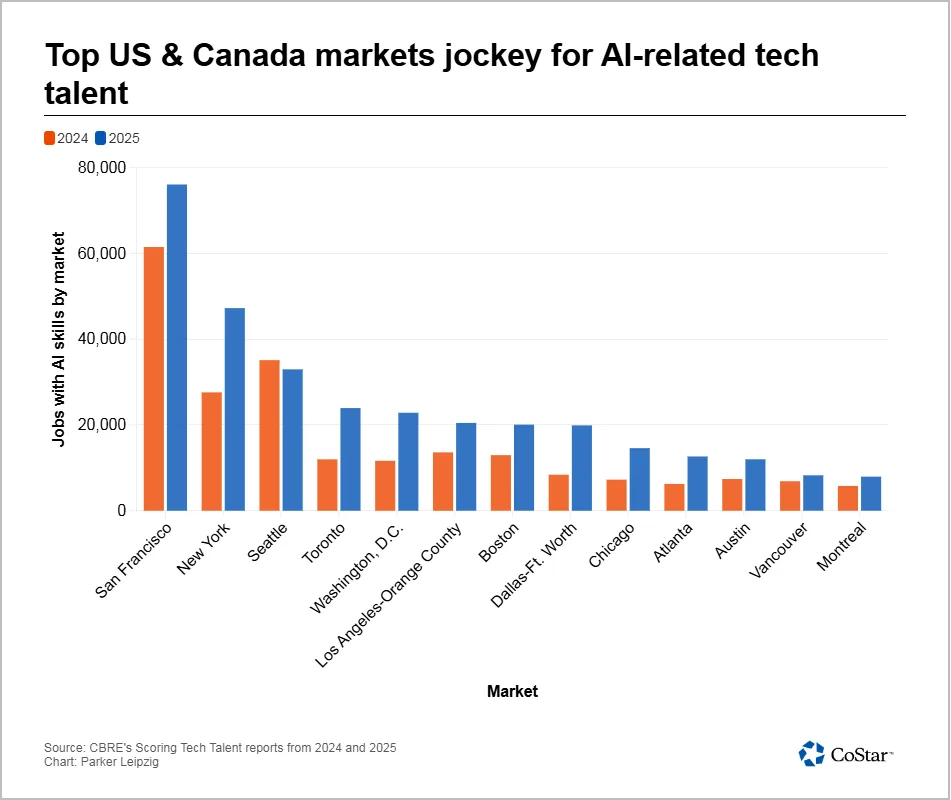
CBRE is tracking around 1.5M SF of AI-related office demand currently in the pipeline. It’s a positive sign for cities still struggling with high office vacancy. In San Francisco, where office vacancy remains above 30%, CBRE executives say AI leasing conversations now dominate the real estate landscape.
But Long-Term Office Demand Is Less Certain
Despite short-term leasing gains, experts remain cautious about AI’s lasting impact on office demand. The automation potential of AI is already replacing thousands of jobs. Ongoing mergers and acquisitions in the sector could lead to even more consolidation.
“AI company growth is very fluid,” said Jeff Eiting of Site Selection Group. “For every company expanding, there’s another being acquired — and possibly downsizing.”
Talent Costs VS. Office Costs
The San Francisco Bay Area also leads in tech wages, with average salaries reaching $193K per year, about $33K more than in Seattle. Office rent remains a major cost driver, with Manhattan and San Francisco commanding annual rents of $4.9M and $4M, respectively, for 60K SF.
Still, cost-efficiency is driving growth in secondary markets. Canada saw a tech employment growth rate of 5.9% in 2024, compared to just 1.1% in the US.
Rising Tech Hubs
This year’s report saw Waterloo, Ontario break into CBRE’s top 10. The city jumped 11 spots thanks to rapid job growth in AI-focused roles and a lower-cost environment that’s drawing in investment.
Waterloo now anchors what CBRE calls an “innovation corridor” west of Toronto, positioning it as a cost-effective magnet for tech employers seeking to retain talent without crossing the border.
Why It Matters
AI has become a temporary lifeline for the office market in high-cost cities. It offers a rare sign of hope in a sector still recovering from the pandemic. However, the dual role AI plays — as both job creator and job eliminator — means its long-term impact on office real estate remains far from certain.
What’s Next
CBRE expects more high-profile AI leasing deals to roll out through 2026. However, office demand will keep evolving as companies weigh innovation, costs, and workforce changes.
The firm’s report underscores a broader trend: AI isn’t just reshaping industries — it’s redefining where and how people work.